
.avif)


1301 K Street NW
Suite #300
Washington, DC 20005

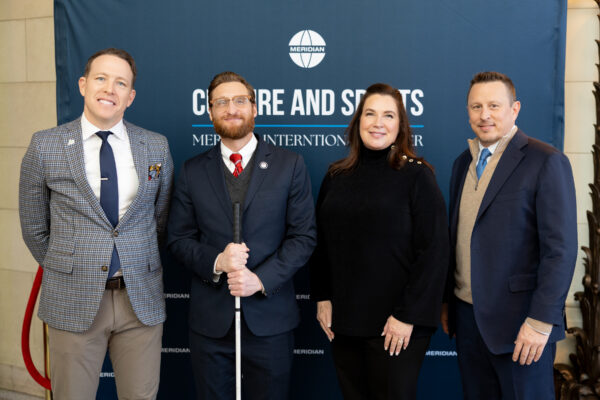
As global competition intensifies and the lines between diplomacy, security, and culture continue to blur, Meridian International Center convened this conversation to examine how sport operates as a powerful platform for international engagement, alliance-building, and civic cohesion.
Opening remarks from U.S. Navy Veteran, three-time Paralympian, and six-time Paralympic Gold Medalist, Brad Snyder grounded the discussion in lived experience, illustrating how sport provides solace, catharsis, and renewed purpose for service members navigating life after injury. Snyder emphasized the responsibility of sports institutions to create pathways for empowerment, noting that “we take very seriously our obligation as leaders across all sports programs to ensure opportunities for empowerment—especially for military veterans.” His remarks set the tone for a broader examination of how athletic platforms support resilience, leadership, and continued service.
The panel, moderated by Travis Murphy, CEO of Jetr Global Sports & Entertainment, with Michelle Strauss, the Chief Executive Officer of the Strauss Family Office, President of the Patton Foundation, and Chairman of Patton Legacy/Sports, and David Kerner, Co-Chair of the 2027 Military World Games, explored how sport is not ancillary to service, but an extension of it—supporting recruitment, readiness, and public understanding.
For many service members, sport is not a pastime, but a lifeline. Brad Snyder’s journey from catastrophic injury in Afghanistan to Paralympic gold underscores how sport can restore purpose after trauma. His experience echoed a broader reality discussed throughout the panel: thousands of veterans face difficult transitions at home, and adaptive and competitive sports offer structure, identity, and community when traditional pathways fall short. These programs do more than rehabilitate bodies; they reaffirm service members’ value to society, reinforcing that injury or disability does not diminish one’s ability to lead, inspire, or contribute. Sport becomes a continuation of service by other means.
The panel challenged the outdated notion that sport is merely “soft power.” As Travis Murphy emphasized, international sport now functions as a serious instrument of diplomacy, influence, and alliance-building—operating alongside, not beneath, traditional military and political tools. In a global environment where values are contested and visibility matters, sporting platforms project democratic ideals, reinforce cohesion, and create neutral ground for dialogue. Whether through multinational competitions or veteran-centered initiatives, sport increasingly shapes how nations signal leadership, partnership, and credibility on the world stage.
Michelle Strauss’s Remembrance Project illustrates how sport can preserve history while educating future generations. Rooted in a football game planned—but never played—by World War II soldiers during the Battle of the Bulge. Today, that legacy lives through the Remembrance Bowl, an annual game in Normandy between active-duty soldiers, where commanders also take the field; jerseys are signed as symbols of camaraderie, and challenge coins are exchanged. By pairing athletic competition with classroom-based civic curricula, the initiative connects students to sacrifice, service, and national memory before they ever step into a stadium. This approach ensures that remembrance is not passive or ceremonial, but participatory—linking historical understanding to shared responsibility and civic pride.
Set to take place in the United States for the first time in 2027 in Charlotte, North Carolina, the Military World Games are among the largest sporting events in the world. Founded in 1919 under the theme “friendship through sport,” the Games will convene athletes from 142 countries across more than 37 sports, including military-specific competitions. David Kerner described the Games as a celebration of “peace through sport,” with competition replacing conflict as a means of international engagement. Similarly, Kerner noted that more than half of the athletes expected to compete in the 2028 Los Angeles Olympics will also participate in the Military World Games, underscoring the deep integration between military service members and the global elite sports ecosystem. The Games highlight active-duty service members, blending elite athleticism with military service, and by hosting the Games publicly, rather than solely on military bases, it signals a strategic shift: making military cooperation, athletic excellence, and international friendship visible to civilian audiences at home and abroad.
As military recruitment challenges persist, panelists pointed to sport as an underutilized pathway to service and readiness. The World Class Athlete Program (WCAP) demonstrates how athletic excellence and military careers can reinforce one another, offering young athletes alternative routes to serve while competing at the highest levels. Expanding these models across branches could strengthen recruitment, enhance global competitiveness, and modernize how service is perceived by the next generation. Ultimately, sport offers the military not only a recruitment tool, but a narrative—one that frames service as opportunity, discipline, and global engagement rather than sacrifice alone.

Tell us where you’re trying to go or what you’re trying to accomplish.
We’ll clear the path to get you there.